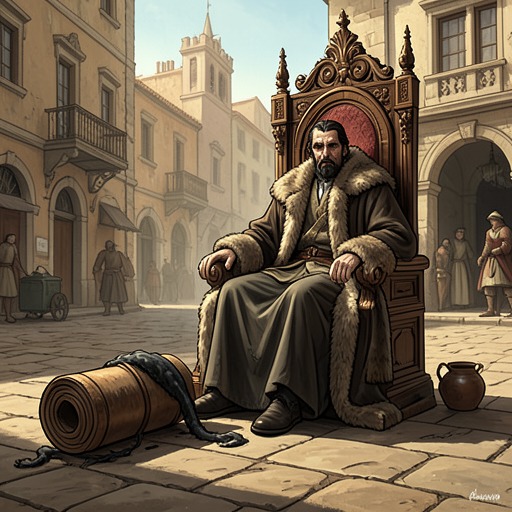
He who is the cause of another's greatness is himself undone
The PrinceHe who is the cause of another's greatness is himself undone is a general political axiom about the danger of creating a power that can later threaten its benefactor. In the discussion of King Louis's loss of Lombardy, the principle names the decisive error beneath a chain of military and diplomatic misjudgments: France strengthened the Church and brought Spain into Italy, then found both powers contributing to France's ruin. The expression joins political causation to strategic responsibility, warning that assistance becomes self-destructive when it raises an independent actor capable of turning against the one who enabled its rise.
Formulation and Immediate Context
The maxim appears after the account of King Louis's six blunders. Louis destroyed weaker States, strengthened an already powerful Prince, brought a very powerful stranger into the country, failed to reside in the conquered territory, failed to send colonies, and finally deprived the Venetians of their dominions. The sixth error was especially damaging because the earlier decisions had already altered the balance of power in Italy.
Louis had ceded Romagna to Pope Alexander VI and Naples to Spain in an attempt to avoid war, while also allowing Venice to be ruined. Yet the reasoning rejects the idea that war can safely be avoided by surrendering strategic advantages: conflict is merely deferred to the disadvantage of the power that retreats. Once the Church and Spain had been enlarged in Italy, France had forfeited the restraint that a powerful Venice might have imposed on other ambitions in Lombardy. The immediate concessions therefore did not remove danger; they redistributed it among stronger rivals.
The Church, Spain, and France's Reversal
The maxim is sharpened by a conversation at Nantes with Georges d'Amboise, when Cesare Borgia, the son of Pope Alexander VI, was occupying Romagna. Georges d'Amboise argued that the Italians did not understand war. The reply inverted the accusation: the French did not understand statecraft, because otherwise they would never have allowed the Church to become so powerful.
The subsequent course of events supplies the maxim's proof. France helped produce the political and territorial strength of the Church and Spain in Italy, and those enlarged powers then became agents of France's ruin. The causal sequence matters more than any single battle or treaty. A ruler may gain an immediate advantage by empowering a partner, but the partner's new strength changes the future field of action, creates distrust, and can make the original benefactor dependent on the very power it has raised.
Strategic Mechanism
The expression does not condemn every alliance or every act of assistance. Its target is the careless elevation of a power whose interests can diverge from the benefactor's. The danger operates through both address and force: whoever raises another to power must either persuade or compel that newly strengthened actor, and each method breeds distrust. The benefactor thus creates a rival while also giving that rival grounds to resist control.
The same logic recurs in the counsel to use the lion and the fox. A ruler must recognize snares as the fox and repel wolves as the lion, but reliance on force alone is insufficient. Political strength must be managed with judgment, because an actor that is powerful enough to be useful may also become powerful enough to dictate terms. The maxim therefore belongs to a wider account of power as relational and unstable rather than as a possession that remains under its creator's command.
Alliances, Dependence, and Political Choice
The principle also clarifies the argument against joining a stronger power unnecessarily. A State should not ally with one stronger than itself in attacking others unless necessity leaves no alternative, because victory would place the weaker ally at the victor's mercy. The Venetians could have declined to join France against the Duke of Milan, but their alliance helped bring about their ruin. The example reverses the maxim's direction without changing its structure: political actors are endangered when they help enlarge a superior power or voluntarily place themselves beneath one.
The discussion of neutrality extends the same strategic problem. When powerful neighbors fight, refusing to choose can leave a ruler despised by the victor as a doubtful friend and ignored by the vanquished as someone who would not share his fortunes. Openly choosing a side can create obligations and future friendship, whether that side wins or loses. Yet the choice remains dangerous, since every policy carries uncertainty and escaping one mischief may lead into another. Prudence therefore lies in distinguishing degrees of disadvantage rather than imagining that political action can eliminate risk.
Rhetorical and Thematic Significance
As a maxim, the sentence compresses a long chain of political causation into a memorable reversal: the agent of another's greatness becomes the victim of that greatness. Its force is primarily logical, since the surrounding argument moves from identifiable decisions to an observable reversal of power; it also gains authority from the concrete cases of France, the Church, Spain, and Venice. The wording turns assistance into an accusation against the helper's judgment.
The expression's broader premise is that power must be acquired and preserved with equal care. A ruler who concentrates only on immediate gains may mistake enlargement of an ally for enlargement of his own security. The resulting irony is structural: the benefactor appears powerful at the moment of creation, yet the created power survives the original advantage and eventually limits or destroys its maker. In this sense, the maxim is not merely a warning about generosity. It is a rule about unintended consequences, alliance design, and the political cost of making another actor strong enough to become independent.